Showing posts with label Holy Week. Show all posts

Monday, April 9, 2012

Terrifying Good News
(an Easter homily)


Alleluia!  Christ is risen!
The Lord is risen indeed, Alleluia!

Praise God!  It’s good to see you.  Good to be gathered together like this.  Family and strangers and good friends next to awkward acquaintances.  All together.  All in praise.  Singing Christ is alive!  Alleluia! 

So this pastor is making a visit to a dear parishioner of his parish, become homebound.  “Door’s open” she hollers, as he knocks on the door, and he comes in, finds a seat on the couch near her reclining chair.  He’s brought the blessed sacrament, but they spend some time on the front end just catching up.  As they begin to talk, he spies a bowl of almonds on the table.  He skipped lunch that day to make time for the visit, and his stomach feels like it’s about to growl and give him away.  He helps himself to an almond.  She talks.  He listens.  He talks.  She talks again, and all the while he’s eating almonds.  By the end of the visit, he looks at the bowl and, in embarrassment, tells her, “I’m so sorry, I seem to have eaten through your entire bowl of almonds.”  “No, no, father, don’t be sorry,” she says.  “I’d already sucked all the chocolate off of them anyway.”

This to me is a picture of Easter.  Easter, the time of eggs and parties, bright dresses and flowers and bunnies.  God help us, the bunnies.  But just what is left when the chocolate’s sucked off?

Jesus, conceived by the Holy Spirit, born of Mary, become a teacher, calling disciples, surrounded by friends, breaking bread and wine with his friends, become a cult hero among the crowd who thought he would bring holy war, become a threat to the religious and political establishment who feared he would bring holy war, then killed on Good Friday.  Today, raised by God.  This is the strange and marvelous story of Holy Week.

This is our story with the chocolate sucked off. 

What do we do with this story? 

This morning I want to say that it is okay if you don’t know what to do with this Easter, the chocolate-less Easter.  It’s fine to not know what it means.  In fact, as a priest and preacher going on six years now in God’s Church, I think that to not know may be the only honest thing a person can do.

Now, some will say I’m over-thinking the matter, that the meaning and message of Easter is obvious and clear: He is risen!  Alleluia!  And that’s right.  Let us sing the praises loud and gladly.  Let joy abound.  Let’s make up for forty days’ lost time and say it over and over again: Alleluia!  He is risen.  Easter need not be more complicated than that.

Yet, but, and...  We turn to our gospel today.  Consider the uncertain picture:

Mary and Mary and Salome have made their way to the tomb.  It’s early yet, but the Sabbath is over so the law allows them to anoint Jesus’ body properly.  They fuss on the way about who will move the large stone from the tomb, but when they arrive, the tomb is already open, the stone rolled away.  Like coming home from vacation and finding the back door unlocked.  More than that, there’s someone inside: a young man.  The Good News of Easter begins with all the joy and gladness of an unexpected late night visitor discovered in your house, rifling through the fridge.  These women are panicked.  They are terrified.

It gets worse: the young man fails in his attempt to comfort the women.  “Be not alarmed.”  You can imagine, catching a strange man in a place as intimate as this, in the early morning hours, and he calmly turns to you and says that: “Be not alarmed.”  This is a tomb!  This looks like grave robbery.  This is desecration of the holy, disrespect for the dead!  “Do not be alarmed,” he says.  “You are looking for Jesus of Nazareth, who was crucified.  He has been raised; he is not here.  Look around, see for yourself.  Go, tell the disciples and Peter...”  Go, tell, he tells them.  And...

You would think that if the meaning of Easter were obvious and clear, the women would have gone and told.  Instead, we’re told that they fled from the tomb, for terror and amazement had seized them; they said nothing to anyone, for they were afraid.  Later, they briefly tell Peter.  Let me ask you: How do you briefly tell Peter the news that the man he called the Christ, the Messiah, the Son of the living God, the man he betrayed is alive, that he’s risen?  But they manage to tell him briefly, like an older parent manages to tell a concerned child he’s going in to have some tests run.  They manage to slip it in.  They tell the disciples briefly, we’re told.

“Oh by the way...”

It isn’t until Jesus himself meets them and sends them that they go, tell, from east to west, the sacred and imperishable proclamation of eternal salvation.

An empty tomb is not enough.  Jesus himself must meet them.  Just as he must meet each of us.  And so we gather in the place where he promises to meet us, and we await the risen Lord.

It’s okay not to know what comes next, after Easter.  Okay if you don’t know what to do with it.  Indeed, if you told someone the story: that God was born in the flesh, as one of us, that he lived and taught and challenged those in power, that he was welcomed to Jerusalem as a king and, less than a week later, was crucified on a cross, and that after three days he was raised from the dead and appeared to his friends...If you told that story to a stranger and she nodded her head at each point, “yes, yes, very good, I understand, yes,” you might rightly think she wasn’t listening to you!  Today is not the day of ordinary common sense, but of the impossible possibility come alive.

The story of God become flesh, incarnate, and killed, then risen from the dead isn’t supposed to make obvious sense.  But it means to get our attention.  It’s supposed to surprise us.  To jar us.  To make us say, “Come again?”  The story of God become flesh, incarnate, killed, risen from the dead is supposed to leave us with the distinct and clear impression that we don’t know it all - that we are not as in control of our lives or this universe as we’d like to believe, that the story is not up to us, that in fact it might not belong to us, that in the mystery called Father, Son, and Holy Spirit, we are dealing with what CS Lewis famously called “not a tame lion.”

When we grow too comfortable with the story, when we catch ourselves beginning to presume upon the story - like it must be this way, like God didn’t choose this way on his own - we risk losing sight of God’s outrageous act for us:

Jesus Christ is risen from the dead!

German theologian Dietrich Bonhoeffer gets at it this way:

"Good Friday (the day Jesus is crucified) is not the darkness that necessarily must give way to light. Nor is it the winter sleep or hibernation that stores and nurtures the germ of life. Rather, it is the day when the incarnate God, incarnate love, is killed by human beings who want to be gods themselves.  It is the day when the Holy One of God, that is, God himself, dies, really dies - of his own will and yet as a result of human guilt, and no germ of life is spared in him such that his death might resemble sleep.  Good Friday is not, like winter, a transitional stage.  No, it really is the end, the end of guilty humankind and the final judgment humankind pronounces on itself.  And here only one thing can help: God’s mighty act coming from God’s eternity and taking place among humankind."

God’s mighty act: on this day the Lord has acted.  We will rejoice and be glad in it.

We take the pains to rehearse the passion daily during Holy Week in part to learn that resurrection means the living of the God who was dead as hell on the cross.  Today is not our celebration of sunshine or bluebonnets or tropical climates winning the day in the course of the natural cycle of things.  Today is the inexplicable, unexpected, surprising Good News that death - our own and God’s - will not, cannot separate us from the love of God in Christ Jesus our Lord.

If the first women who learned the news were startled at the tomb, how much more when Jesus came to them, appeared to them, and said “go, tell.”  The end is not the end.  God has made them characters in a play whose script belongs to God alone.  No one knows what will happen next.  They are more afraid than ever.  Sometimes living can be more frightening than dying.  All that not knowing.  And also with us.  Terrified and afraid.  Yet they - and we - know the one thing that matters: Jesus is alive.

The frontier ahead is known to God, but not to us.  So we will baptize Laura not into the illusion of our own certainties, but only into the certainty of God’s love for her: the death and resurrection of Jesus.  And this love beyond our knowing both surprises and scares us. 

If we are honest, we cannot imagine death, much less resurrection.  We cannot imagine peace with our neighbor, much less the forgiveness of our enemy and an end to war, the killing of people different from ourselves.  But we are learning to trust the imagination of God.  And we dare to trust the imagination of God on these grounds:

The same God who died for you lives for you today.

Alleluia!   

Happy Easter.

Amen.

Thursday, April 5, 2012

Did St Peter Have Bunions?
(and other questions from Maundy Thursday)

I wonder if St Peter had bunions or - at the very least - smelly feet.  He almost certainly had calluses.  Cracked soles and calluses.  That’s all but certain: all that travel, walking, talking, on unpaved, dusty roads.  But bunions are admittedly a matter of speculation. 

Peter, I suspect, could be hard on his feet.  And his knees for that matter.  Running headlong.  Without the benefit of orthotics, I wonder how well the disciples did in sandals. 

Did James’ feet over-pronate, like my own?  Were there any flat footers among the holy twelve? 

Was the strike pattern of each disciple - heel to toe or mid-foot strike - something one could discern by studying each foot?

Whatever one’s journey, the feet likely know the full burden of that journey best.  Which is why in World War II and Korea, my grandfather believed that the secret to survival began with good socks. 

On that night around the table with Jesus and his friends, despite his initial protest, I wonder what story St Peter’s feet had in mind to tell.

You put your history in another’s hands when you hand them your foot.  That’s not always easy.

Not that most people are looking to decode it.  Foot-reading is a sorry substitute for face-to-face relationship; friendship born of trust and time.  But it’s true, I think, that our bumps and scars remind us of ourselves at least, and we feel a bit like open books, or naked, and so we grow self-conscious. 

I wonder if this isn’t why we tend to contract out intimate exchanges like pedicures and doctors visits and even haircuts to professionals, not our friends.  In the hands of a professional, a haircut is commonplace.  In anyone else’s hands, my hair is an intensely personal, intimate space.

A friend of mine liked to talk about his “body bubble” - his sense of physical, personal space - the space to which he reserved the right to grant or deny access.

I wonder if Judas felt self-conscious as Jesus, having stated his intention, wrapped the towel around his waist and began to wash their feet.  Was he afraid that his feet might betray the story of his brokenness, his secret intention on that night, that his feet might become a window to his soul?

Vulnerability, even the simple vulnerability of naked feet, is scary because it seems like such a slippery slope.  Which is why children learn at an early age to lie about trivial things.

Hiding one’s self - that was the outcome of the very first sin: Adam and Eve, in love with God, too ashamed of themselves to be present to God.  We know that these three great days of Holy Week are about Jesus undoing the sin of Adam: that Adam ate from a tree and Jesus will die on one; that Adam sentenced humanity to death and Jesus will raise in himself all humanity to eternal life with God.  In three days’ time we will know these things, but consider how the undoing of Adam - or better said, the reclaiming of Adam - begins with these friends around this table and the towel tied around his waist:

Where Adam and Eve hid from God, here is the Great Physician present to his people, on his knees, tending their once-hidden wounds.  Washing them clean with his hands.

The hiding is ending. 

And God the Father, for his part, who has given all that he has to the Son, will take what belongs to the Son and declare it to them, these holy twelve.  The hiding ends when they hand him their feet, and also as he kneels on the floor and takes off his robe.  No more hiding.  Second Eden.

So this is what tonight is about: God in Christ Jesus means to make them his friends.  Friends of God.  And he means to make the same of us.

What a wonderful and terrifying thing, to be made friends of God.

Wonderful because I had thought he would want nothing to do with me.  Terrifying because I realize he will want everything to do with me, and I know so much about myself, and I know full well where his story is going, how terrifying the next three days will be, what they will cost.  Terrifying because, once made God’s friend, I know I am no longer my own.

But what can I want as much as friendship with God?  For what else was I made?

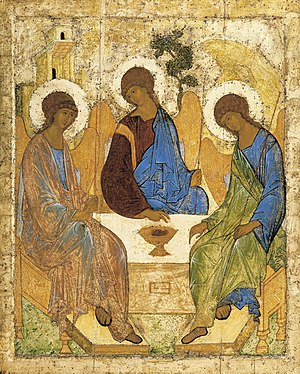
So I look up at the table, at the feast that is prepared, and Christ himself is the feast.  And I think of this image. 


It’s a 15th century icon of the Trinity.  A picture of three strangers who appeared to Abraham and Sarah when this long pilgrimage as God’s people was only beginning.  The very beginning, and these strangers came and Abraham fed them, and the early Church saw this as the clearest (maybe the only clear) depiction of the Holy Trinity in the Old Testament.  And there is much that we might observe about this picture, but one thing that the church through the ages has made especially clear: that there is a spot remaining at the table - that only three sides are taken, and that we, in a sense, are already seated at the table, if pushed back a bit, reclining.  And this picture of God’s people at the table with and as the family of God is what the whole story of God has been hoping for and building toward all along. 

Tonight it happens.  The dream of God so close we can taste it.  God at table with his friends.  And we are his friends.  Drawn into the communion of the vulnerable.  The callused.  The ones with worn souls.  Still here is our hope: we are no longer hidden or hiding from God, but he is binding our wounds, feeding us with himself, and giving us the strength and charge to feed one another and others with the food and drink that we find here.  Bread and wine.  His body.  His blood.  Flesh and forgiveness.  The cup of forgiveness.  Poured out for you. 

“Love one another,” he says.  “As I have loved you...”

Made friends of God, love one another.

Amen. 

[Maundy Thursday sermon, preached April 5, 2012, St Christopher's by-the-Sea]


Maundy Thursday Word Cloud

Word cloud for Maundy Thursday.  See you tonight at 7 p.m.


Sunday, April 1, 2012

Palm Sunday Wordle

I'm sometimes a late bloomer with respect to technology fads.  Late or not, I think this one is stellar: "Wordle" takes in your text and visually represents it based on emphases, word choice, repetition, etc.  As an example, here is the visual picture of St C's sermon from Palm Sunday. Cool, huh?


Fools, Ashton Kutcher, & the Kingdom of God
(death, you've been punk'd)

For the first time in years, it has been easy for me to remember the date of Easter day.  Easter day, of course, is worth remembering, especially for Christians.  But for various reasons, it isn’t always easy for me to remember.

But easy this year.  Easy because April 8th, Easter day, is one week after April 1st, Palm Sunday, today.  And April 1st is of course also April Fools’ Day. 

[Off the top of my head, I could not remember the last time this happened.  So I looked it up: 2007.  Not that long ago.  Five years.  But consider that the next closest time was 1928 (and 1917 before that).  And consider that it won’t happen again until at least 2090, and there I’m only making a conservative guess based of the fact that my handy Easter calendar doesn’t go past 2089.  Said handy Easter calendar correctly assumes that I will not need to concern myself with Easter planning beyond 2089.  God willing, and for some perspective here, Jude - my six month old son - will be seventy-seven years old the next time, in God’s good sense of humor, Easter day and Palm Sunday could potentially land on April 8th and April Fools’ Day, respectively.  No fooling.](1)

Now, April Fools’ Day jokes usually follow a predictable form - think here of Candid Camera or Ashton Kutcher’s Punk’d on MTV: you start with the awkward predicament, you give it some time to build in tension and suspense - you watch as the awkwardness ferments - then, after some squirming, the predicament is resolved by the punch line that doesn’t come until the end: the punch line that announces that it’s all been a joke - that you’ve been mislead - the joke’s on you - and the rest of us are laughing because you’re the only one who didn’t know. 

As a kid this pattern could be especially simple (and not especially funny): “There’s a spider on your head!”, for example.  That’s the predicament.  Now give it some time - watch the reaction: the jump, panic, or scream.  Long enough...  “April Fools!”  That’s the punch line.  Now duck, and run like heck.

And this to me feels a lot like Palm Sunday.  A really bad joke.  Only it’s hard to know who exactly is being played.  So much goes so wrong so quickly.  And none of it is funny. One moment Jesus is riding into Jerusalem to chants reserved for kings, the next moment he is strung up on a cross, left for dead, hanging between two thieves.  He’s wrapped in a cloth, entrusted to a tomb, swallowed up by the earth.

Surely the disciples were left looking for the hidden camera somewhere.

The disciples had bet their lives that Jesus was the one.  The one in whom the hope of Israel was set.  “You are the Messiah, the Christ, the Son of the Living God,” they said.  This is the one.  The savior in whom they had put their trust, giving up what they had - all that they had - for the chance to follow him.  Some people have that glow, like merely staying near them will lead to good things - and so you do.  He had awakened their dreams.  They began to believe in God’s promise again, meant for them, not a dry word in a book, not a fossil from an ancient past - but alive, meant for them.  They left their families.

They had followed him around for three years, watching as he healed the sick, raised the dead, and their hearts stirred alive from the insides with the insurmountable, unmistakable yearnings of true hope.

And now his disciples, turned deserters in the moment of crisis, peer out from the shadows and steal a glance at the cross where they see him: covered in blood, April’s Fool.  And they were fools to follow.

You start with the awkward predicament - in this case the sky-high hope - you give it time to build in tension and suspense - you watch as the awkwardness ferments - then, after some squirming, the predicament is resolved by the punch line that doesn’t come until the end: the punch line that announces that it’s all been a joke - that you’ve been mislead - and the rest of us are laughing because you’re the only one who didn’t know.

Was it all the other way around, I wonder?  Was it Jesus made a fool when every last one of the friends he had poured himself into these past, last three years scatter like roaches to darkness as lightning tears the sky in two?  Had he been a fool to call them his friends?  Or was Jesus made a fool long before those faithless few - was Jesus made a fool by the God who once upon a time had called him his beloved, who now, to everyone with eyes to see, appears to have given him up for dead on the cross?  “My God, my God, why have you forsaken me?” 

Some people say that they cannot call God “Father” and that we would understand if we had ever met their father, that their father was cruel or absentee, nothing like God the Father, but here is Jesus crying from the cross, forsaken, abandoned, made to feel like an orphan.  It is ironic, I think, that in what Jesus names as the moment of divine desertion, the centurion learns to call him God’s Son. 

Was God the fool for believing that if he sent his Son to this vineyard, to these people, they would treat him any differently than the prophets who came before him?  Did God’s stubborn insistence on a thankless creation make him the biggest fool of all?

And what about us?  Here.  Gathered with palm branches in our hands, pinned to our chests, more than two-thousand years later:

Are we fools to look to this Christ on this cross for our hope and our life?
Are we fools to believe that we will not also desert him?
Is God made the fool again to believe that we vineyard workers will receive him any differently than the ones who came before us?

Today’s story is a tragic story made tragic because it is impossible to know who is fooling who.  We assert our innocence in the face of suffering and perceived injustices - we demand our just due.  But deep inside we know better: we are no better.  Swirling folly.  In and through it all, glancing up at the cross, we cannot escape the sneaking suspicion that on this day and all on all our days, daily in our lives, we are only fooling ourselves.

This is what we learn about ourselves on Palm Sunday, I think, as hosannas turn into cries to crucify our king.  The crucified king.  “This is the king” the sign said over his head.  But two thousand years later, he’s still our King.  How does this happen?  How does this make sense?

Two thousand years later, he’s still our King because there is one more fool to be revealed before this Holy Week is through: and the last fool’s name is Death. 

One week hence and we will see it, we will shout it with St Paul: “O Death, where is your sting?  O Hell, where is your victory?”  In the words of the tradition’s great Easter sermon: “[death] took a body, and face to face met God!”

Death, you’ve been punk’d.

You start with the awkward predicament - the death of God’s Son - you give it some time to build in tension and suspense - you watch as the awkwardness ferments - then, after some squirming, the predicament is resolved by the punch line that doesn’t come until the end and - this is the great surprise - death is not the end: but resurrection comes as the punch line that announces that it joke is not the one we thought it was - that Death has been foiled - and all creation will soon be laughing because of the victory of God’s Son.

April Fools. 

Plenty of fools on this, our Palm Sunday.  Plenty more to be discovered in the events of Holy Week along the way to the victory of our God.  As you travel the pilgrim road this Holy Week, as you journey the way of the cross, don’t forget what fools are: a fool is someone who doesn’t make sense.  A fool is someone who doesn’t grasp the reality of their present circumstance.

Holy Week changes everything we thought we knew about reality and our present circumstance, beginning with the king who reigns from the cross. 

Today begins the week whereby Death is made a fool.  Fear follows close behind.  Because this week is true, Death and Fear are fools.  The old common sense of violence, hatred, might makes right, and the accumulation of wealth at the expense of my neighbor are exposed as whimpering attempts at a power that escapes them.  They made sense before, but in this light, no more.

Similarly, you and I are invited by this week, invited by our baptisms, to live into this question: How might I live in such a way that is foolish - makes no sense - unless Jesus Christ was born in the flesh, crucified on the cross, and is risen from the dead?  What would it take for others to say of us: “the only way what they do holds together, makes any sense at all - is in any way intelligible, is explicable - is if the Jesus who was crucified lives today as their King”? 

Amen.

_________

(1) I've since learned that the guess wasn't far off: 2091, for those scoring at home.

A sermon preached April 1, 2012, Palm Sunday, at St Christopher's by-the-Sea

Palm Sunday: an Exhortation from the Early Church

From a sermon of Andrew of Crete, Bishop and Hymnographer [740]

So let us spread before his feet, not garments or soulless olive branches, which delight the eye for a few hours and then wither, but ourselves, clothed in his grace, or rather, clothed completely in him.  We who have been baptized into Christ must ourselves be the garments that we spread before him.  Now that the crimson stains of our sins have been washed away in the saving waters of baptism and we have become white as pure wool, let us present the conqueror of death, not with mere branches of palms but with the real rewards of his victory.  Let our souls take the place of the welcoming branches as we join today in the children's holy song: "Blessed is he who comes in the name of the Lord.  Blessed is the king of Israel."

Wednesday, March 14, 2012

The Day I Stopped Preaching

I first shared this as a Good Friday meditation, back two years ago, but it's been echoing in my mind as I listen to this coming Sunday's readings for Lent 4: the snake on the pole to heal the people, with John's gospel to tell us that Christ is the snake lifted up on the pole.  I don't offer it now as a direct engagement with those readings - they only score a passing mention here.  That said, as I reread this meditation, I find it a helpful point of entry as we approach Holy Week.

As a personal aside, I will forever remember this meditation with special fondnessIt was Holy Week - my first as the sole priest at a church - and I had a total block.  Overload.  Too much.  I could not preach.  Bek said, "Then don't."  Huh?  "Just respond."  Oh.  My perceived burden relieved, I sat down and fell in love with God's story again. 
_____

Once upon a time there was a forest full of trees, and it wasn’t so much the trees but the one tree that caused the trouble. You know the story. The woman; the fruit; and the man. Serpentine transgressions. Was it gluttony, lust, or pride, I wonder. Peek a boo with God. Selective hearing, maybe. Exile, swords of fire.
A friend of mine said, “avocado.” Avocado? Yes, he said, the fruit that marked the sin. He was probably projecting, but I wonder sometimes what fruit would be shiny enough, just ripe enough, enticing enough that I would dismiss God’s voice to me.
Before too long, the man and the woman were fruitful, found with child, but that had long stopped being an obvious good thing. And it’s fruit again, the parent’s sin, the cry of Abel’s blood. And Abel’s blood’s still crying. Good God, is Abel’s blood still crying.
And every night on channels one through nine, you can see him, hear him, they call him different names, but you can still hear Abel’s blood.
And it’s Abram and Sarai, Moses, Elijah, David, Elisha, Jonah, God bless him, and Nahum and all of God’s prophets, his judges and kings, the high priests of the people, trying to give God back his blood.

Sometimes I pray when I hear it, and sometimes I laugh when I hear it; other times, when I hear it, I sink into my sofa and drip through to the ground, the weight of the sadness slaying my tears and as heavy -- oh, as heavy -- as the flickering light is blue against the wall.
They sprinkled blood, not Abel’s, on their beaten, wooden, doorposts that first, black night called Passover; that first last night in Egypt, just as God commanded. Prefigured Lamb of God. The Egyptians were howling; God, he was faithful, and the Hebrews walked out on dry land. Pillars of cloud. Columns of fire. And the Hebrews walked out on dry land.
But college freshman everywhere will tell you, when they’re talking to you at all, that unexpected freedoms are the hardest kind to handle. And the people who walked free from their mud bricks in Egypt had a hard time believing that the One who had freed them from their mud bricks in Egypt, would keep them, could keep them, from their mud bricks in Egypt. That they would be cared for. That God would bring them home.
And so, in an ironic twist, somewhere along the wandering road, somewhere among the endless, numbered, days that followed, the people who wandered and followed griped one time too many, and God brought back the snake. You know, the one that started the whole mess in the first place. He brought him back. With friends. Satan had been busy. Snakes to bite their heels. Some were even dying.
Moses said, “What the heck, God?” and God had Moses fashion a separate snake, this one made of bronze, and put it on a pole; the people were told to look on the pole in order to be saved. And the ones who did were saved. And some millennia later, the disciple Jesus loved, the one called John, he saw that snake, and called it Christ.
Which brings me to a second tree that caused the trouble. One tree from the forest. You know the story. A man. With some women. And some men. They found him in a garden, with their torches, flaming swords. Sound familiar? Exiled Son of God. Or at least that was the goal.
The disciples had swords, too, but there would be no battle here. No second spill of Abel’s blood. The cup first drunk at Passover, now come before the Lamb. And Peter, who would have fought for him, would not, will not, die with him, and the cock crow names the hour.
They gave the man a trial, the people did. Or close enough to one for their intentions on that day. And they dressed him like a king, and pranced before the powers, and the powers lost their power to the madness of the night. The night as dark as blood. The day that looked like night. And they crucified our Lord.
Once upon a time, this mother, she could smile. But darkness knows no friend.
Two trees by which to see the grief, to hear the cries and taste the blood of wars that will not cease. The rivers flowing blood. Infernal blue light flickering. But eyes to see and ears to hear pick out a pin-prick hope against the darkness, amidst the blood, if faint, if far off, flickering. And this is the pin-prick hope -- God’s own happy sadness -- the moment despair loses hope, becomes futile -- this is God’s secret: the two trees are one tree and his wounds heal the first.
The flaming sword extinguished now, Life’s tree holds high its fruit; and Christ himself, pressed, crushed, for us, becomes the very wine of heaven.
And heaven prepares the song.
Amen.

What the Saints Said, Part iii (Bible Edition)

Part 3 in a series we're calling "What the Saints Said" at St. James. This time, collecting the wisdom of those before us with...